
Ask most security teams where their vulnerabilities are and you’ll get a list of places to look. The network scanner has one set. The cloud console has another. Laptops are tracked in the endpoint management tool, if they’re tracked at all. Container images get checked in the registry, and code issues live in the developers’ platform. Each has its own logins, its own severity scale and its own idea of what “fixed” means.
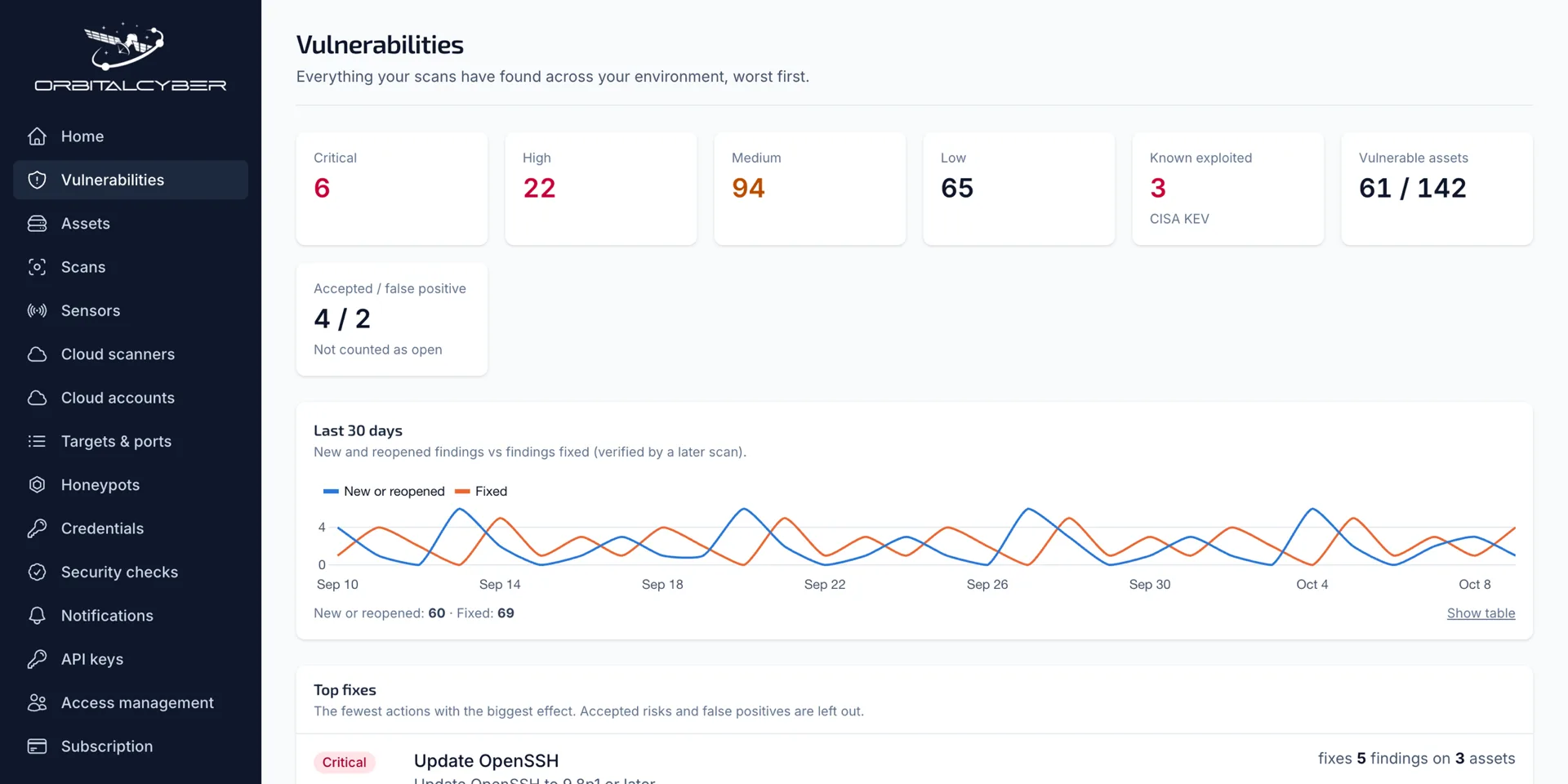
That’s the problem OrbitalCyber was built to solve. Its goal is simple: get all of your vulnerabilities together in one place, across your endpoints, cloud accounts, networks, container images and code repositories, so you can see your real exposure and fix what matters first.
The cost of scattered vulnerability data
When findings are spread across five tools, a few things happen:
- Nobody sees the whole picture. The riskiest issue in the organization might be in a tool nobody checked this week.
- Priorities are guesswork. A “high” in one tool isn’t comparable to a “high” in another, so teams fix what’s in front of them instead of what’s most dangerous.
- Gaps go unnoticed. Laptops away from the office, a forgotten cloud subscription or an old container image can sit outside every scan.
- Progress is hard to prove. Leadership, auditors and customers ask whether things are getting better, and the honest answer takes days to pull together.
Five sources, one list
OrbitalCyber brings each of these into the same console. Every finding lands on the asset it was found on, uses the same severity and status, and is tracked until a later scan shows it’s gone.
Networks and your internet edge
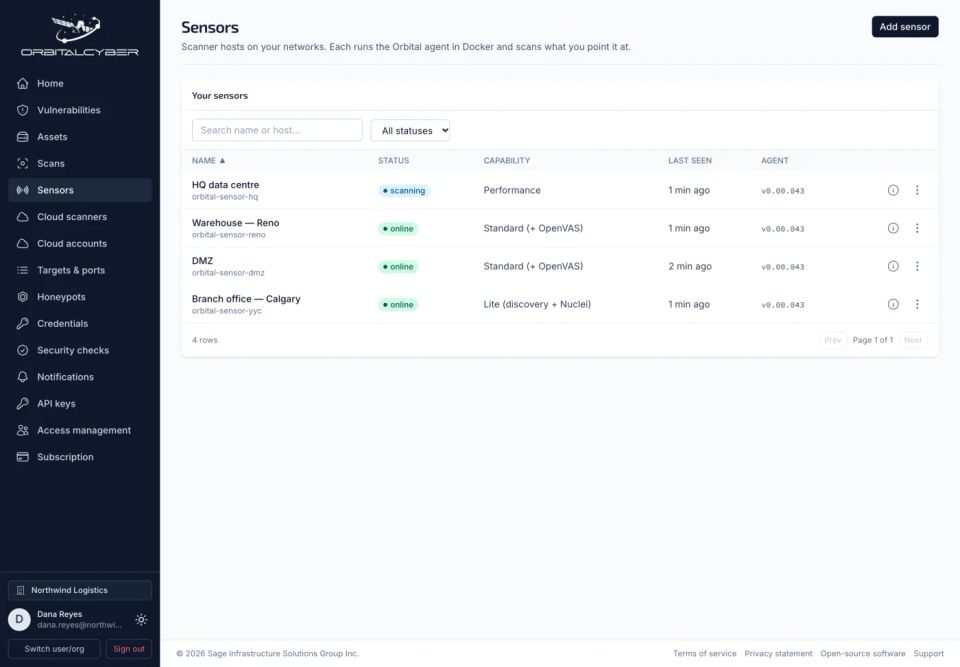
Install a sensor on a Linux host inside each network you want to assess, and use our cloud scanners for your internet-facing systems with nothing to install. Sensors only connect out to OrbitalCyber, so nothing needs to reach into your network.
- Network vulnerability scanning with OpenVAS, including credentialed scans over SSH, SMB and SNMP
- Web, service and misconfiguration scanning with Nuclei
- WordPress core, plugin and theme checks against Wordfence vulnerability data
- TLS/SSL grading for every endpoint
- Active Directory assessments that run on your own sensor, so the domain data never leaves it
Endpoints
The OrbitalCyber endpoint agent runs on Windows, macOS and Linux laptops, desktops and servers. It reports what each computer is and what’s installed, including installed updates on Windows and macOS, and OrbitalCyber checks that inventory against its vulnerability database on our servers. Nothing is scanned on the computer itself, so you see vulnerabilities on machines network scans can’t reach, such as laptops away from the office. Agents only make outbound HTTPS connections, update themselves and roll back if an update fails.
Cloud accounts
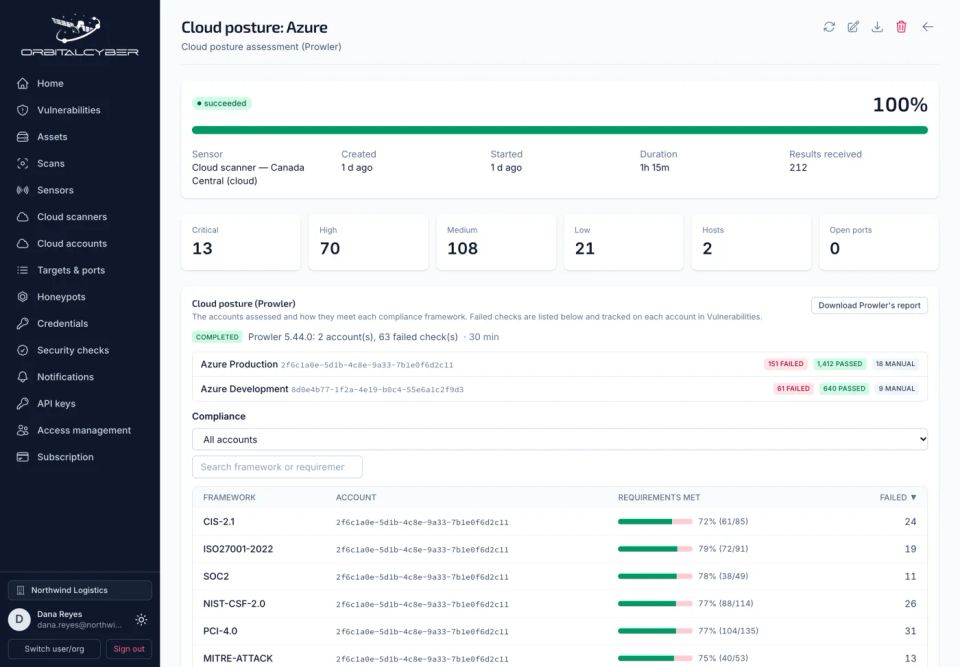
Cloud posture assessments use Prowler to run more than 1,100 checks across AWS, Azure, Google Cloud and Microsoft 365. Each failed check becomes a tracked vulnerability on the account or resource it affects, with a compliance summary for frameworks such as CIS, ISO 27001, SOC 2, NIST CSF and PCI DSS. Run them from your own sensor with read-only credentials, or connect Azure and Microsoft 365 by authorizing OrbitalCyber’s read-only app, without handing over a password or secret.
Container images
Scan the public and private container images you use for vulnerable operating system packages and application libraries, end-of-life base images, leaked secrets and configuration problems such as containers that run as root. Each finding names the installed version and the version that fixes it. Track a registry repository and OrbitalCyber follows its tags over time. Images are inspected, never run, and any secret it finds is recorded by location and type but never stored or shown.
Code repositories (beta)
Code scanning, now in beta on every plan, checks your Git repositories, whether they’re on GitHub, GitLab, Azure DevOps, Bitbucket, Gitea or any other Git server. It finds security flaws in your own code, vulnerable dependencies, committed secrets and infrastructure-as-code problems in Terraform, Kubernetes, Helm, Dockerfiles and CloudFormation. Repositories are cloned and scanned on your own sensors, so your code never leaves your network: only the findings come to OrbitalCyber.
What one place makes possible
With everything in one list, the question changes from “what did each tool find?” to “what should we fix next?”
- Known-exploited vulnerabilities stand out. OrbitalCyber checks CISA’s Known Exploited Vulnerabilities catalog every 12 hours and flags matching findings straight away, without a new scan.
- Top fixes rank the work. Findings are grouped by the action that resolves them, so the fewest changes close the most findings across every source.
- Fixes are verified. A finding closes as fixed only when a later scan no longer sees it, and new versus fixed trends show whether you’re getting ahead.
- Decisions are recorded. Accept a risk, mark a finding as mitigated or flag a false positive, with an expiry or review date, and it stops counting as open.
- Teams get the right access. Roles such as Viewer, Operator and Vulnerability manager map from your organization’s groups, and important actions are recorded in an audit log.
Your data stays on your side
Bringing everything together doesn’t mean sending everything to us. Sensors and endpoint agents only make outbound connections. Scan credentials are encrypted as soon as you save them and decrypted only in the memory of the sensor running the scan. Active Directory data and your source code stay on your own sensors, and secrets found in images or code are never stored.
Getting started
OrbitalCyber plans start at CA$12 a month for personal use and CA$49 a month for organizations, with a 30-day free trial on organization plans. Scans from your own sensors are never metered.
Want help building a vulnerability management program around OrbitalCyber? Talk to our team.